
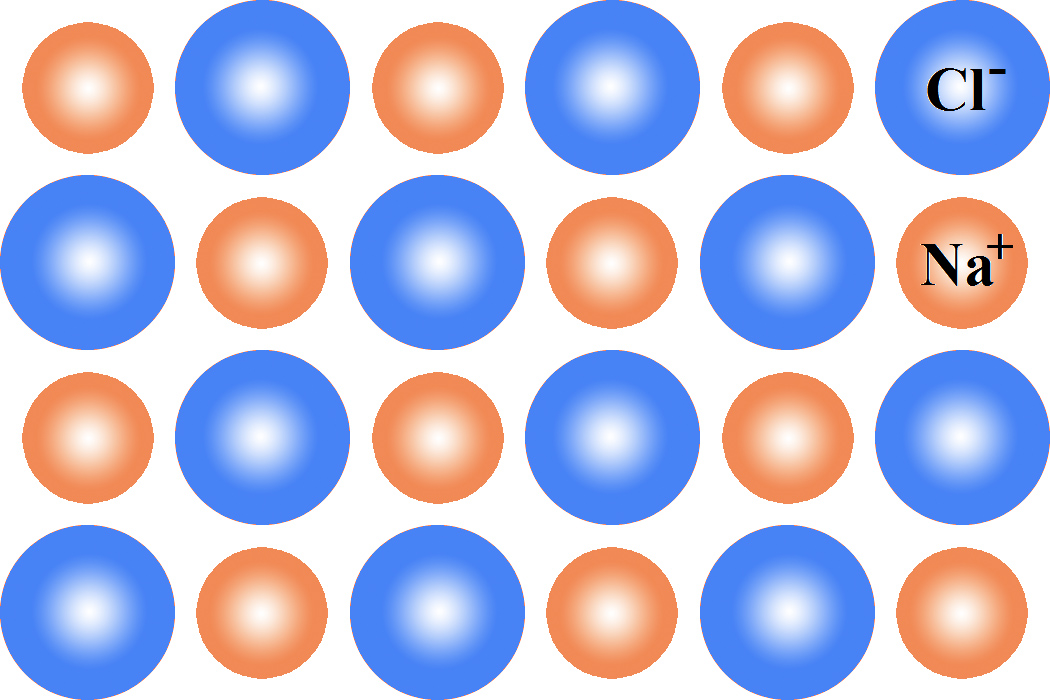
Any deviation from the ideal arrangement of particles in a crystal is known as crystal defect.
TYPES OF DEFECTS
(1)ATOMIC DEFECTS: - This defect arises due to deviation in the perfectly ordered arrangement of atoms in a crystal.
(2)ELECTRONIC DEFECTS:- These defects arise due to electrons in the crystals. At zero Kelvin temperature crystals behave ideally but at higher temperature electronic defects arise in the crystals.E.g. Metal excess defects and impurity defect in covalent crystals are the important examples of electronic defects.
(3)IMPURITY DEFECT: - These defects in the crystals can be created by the process of doping.
TYPES:ATOMIC DEFECTS
- STOICHIOMETRIC DEFECTS
- NON-STOICHIOMETRIC DEFECTS
1) STOICHIOMETRIC DEFECTS
The defects which are found in stoichiometric compounds are called stoichiometric defects. These defects are of two types.
1) Schottky Defect:
This defect arises when some atoms or ions are missing from their
normal lattice sites. Vacancies are created. Crystal remains electrically
neutral.E.g.KCl, NaCl, KBr, CsCl and AgBr.

2) FRENKEL DEFECT
This defect arises when
some atoms or ions are missing from their normal
lattice sites and occupy interstitial sites. Vacancies are created.
Crystal remains electrically neutral.E.g. AgCl, AgBr, AgI and ZnS.

CONSEQUENCES:SCHOTTKY DEFECT
1)Stability of the crystal decreases.
(2)Density of the crystal decreases.
(3)Electrical conductivity increases.
(4)Value of Dielectric constant remains unchanged.
CONSEQUENCES :FRENKEL DEFECT
(1)Stability of the crystal decreases.
(2)Density of the crystal is not affected.
(3)Electrical conductivity increases.
(4)Value of Dielectric constant increases.
CONDITIONS FOR SCHOTTKY DEFECT
(1)Ions should have high coordination number.
(2)Ions should have almost similar sizes.
CONDITIONS FOR FRENKEL DEFECT
(1)Ions should have low coordination number.
(2)Anions should have large sizes than cations.
|
SCHOTTKY DEFECT
(1)Missing ions leave the crystal.
(2)Density of the crystal decreases.
(3)Dielectric constant remains unchanged.
(4)Ions should have high coordination no.
(5)Ions should have similar sizes.
(6) E.g. KCl, NaCl, KBr , CsCl and AgBr
|
FRENKEL DEFECT
(1)Missing ions occupy interstitial sites.
(2)Density is not affected.
(3)Dielectric constant increases.
(4)Ions should have low coordination no.
(5)Ions are large in sizes than cations.
(6) E.g. AgCl, AgBr, AgI and ZnS
|
(2)NON-STOICHIOMETRIC DEFECTS
The defects which arise in non-stoichiometric compounds are called non-stoichiometric defects. These defects are of two types.
- Metal excess defects
- Metal deficiency defects
EXTRA ANIONS OCCUPYING INTERSTITIAL SITES
Metal deficiency defect can also occur due to the presence of extra anions in the interstitial sites of the crystal. To maintain electrical neutrality some cations acquire double positive.

3)IMPURITY DEFECTS
These defects in the crystals can be created by the process of doping.
DOPING
The process of enhancing the electrical properties of the crystals by adding impurities is known as doping.
TYPES OF IMPURITY DEFECTS
1) IMPURITY DEFECTS IN IONIC CRYSTALS:For example when we add traces of SrCl2 in NaCl crystals we get impurity defect in sodium chloride crystals. This improves electrical properties of the crystal.

2) IMPURITY DEFECTS IN COVALENT CRYTALS
These are of two types:
(a)Electron deficient impurity defects
This defect arises when covalent crystals are doped with electron deficient impurity. This defect gives rise to p-type semi-conductors. E.g. When Silicon crystals are doped with electron deficient Aluminium impurity we get p-type semiconductors.

Electron rich impurity defects
This defect arises when covalent crystals are doped with electron rich impurity .This defect gives rise to n-type semiconductors. E.g. when silicon crystals are doped with electron rich phosphorous impurity we get n-type semiconductors.


Q; what is an ideal crystal?
Ans :- The crystal which is free from all sorts of defects is known as an ideal crystal. It has perfectly ordered arrangement of particles.
Q: - What are stoichiometric compounds?
Ans:-The compound in which ratio of positive and negative ions is exactly same as indicated by their chemical formula are called stoichiometric compounds.E.g. Na+Cl- etc.
Q: - What are non-stoichiometric compounds?
Ans:-The compound in which ratio of positive and negative ions is not exactly same as indicated by their chemical formula are called non-stoichiometric compounds.E.g. FeO .
Q: - What are the consequences for Schottky and Frenkel defects?
Q: - Write down the conditions for Schottky and Frenkel defects.
Q: - Give example of Schottky and Frenkel defects.
Q:-Define Schottky and Frenkel defects.
Q:-Differentiate between Schottky and Frenkel defects
Q:-What are the conditions for Schottky and Frenkel defects.
Q:-Why is Frenkel defect not found in pure alkali metal halides?
Ans: - This is due to large size of alkali metals which do not fit into the interstitial sites.
Q: - CaCl2 will introduce Schottky defect if added to AgCl crystal. Explain.
Ans:-Two Ag+ ions will be replaced by one Ca2+ ion to maintain electrical neutrality. Thus a hole will be created in the lattice sites for every Ca2+ ion.
Q: - At which temperature ideal crystals exist?
Ans: - At absolute Zero temperature.
Q: - Why does ZnO appear yellow on heating.
OR
Q:-Why does ZnO exhibit enhanced electrical conductivity on heating?
Ans: - This is an example of metal excess defect due to extra cation occupying interstitial sites. In this case extra Zn2+ ions and electrons get entrapped in the interstitial sites due to which ZnO becomes yellow in color and electrical conductivity of the crystals increases.
Q: - How does density of a solid get affected by Frenkel defect?
Q: - How does density of a solid get affected by Schottky defect?
Q: - What is fool’s gold?
Ans: - It is Iron Sulphide.It shines like gold. Its shining is due to the
conversion of Fe2+ into Fe3+.

Q: - Name the compound which shows both Frenkel and Schottky defects?
Ans: - AgBr.
Q: - What are F-centers?
Ans: - The electrons entrapped in the anionic vacancies are called f-centers.Thsese are responsible for imparting color to the crystals.
Q:- Common salt sometimes turns yellow instead of pure white ?
Ans: - This is the case of metal excess defect due to anionic vacancy that f-centers are created and yellow color is imparted to the crystals of sodium chloride.
Q:-What is doping?
Ans:DOPING: The process of enhancing the electrical properties of the crystals by adding impurities is known as doping.
back next


0 Comments