


CLASSIFICATION OF ELEMENTS
Q: - What is periodic table?
Ans: - The table in which all the elements are classified according to their properties is called periodic table. In this table elements are arranged in the increasing order of their atomic number.In this arrangement elements with similar properties fall under same vertical column The aim of this arrangement of elements into the tabular form is to make their study easier.
HISTORY OF CLASSIFICATION OF ELEMENTS
1)DOBEREINER LAW OF TRIADS
Debereiner in 1829 made an attempt to arrange the elements in groups. He placed three elements in each group. He named those groups as triads. The three elements in a triad had similar chemical properties. He arranged the elements in a triad in the increasing order of their atomic masses. He generalized that the atomic mass of the middle element was nearly equal to the arithmetic mean of atomic masses of first and third element in a triad.

NEWLAND LAW OF OCTAVES
In 1864, John Newland and English chemist and a musician made an attempt to arrange the elements in order of their increasing atomic masses on the basis of eighth note of an octave in music.
According to this law if elements are arranged in the increasing order of their atomic masses, properties of every eighth element resembles with the first element.

Julius Lothar Meyer
In 1869 a German chemist, Julius Lothar Meyer plotted a graph of atomic volume (atomic mass/density) versus atomic mass for various elements. He noticed that elements with similar properties occupied similar positions on the curve. All the alkali metals occupied the peak positions. Thus Lothar observed a periodicity in the properties of elements with atomic masses. This was the first time that a definite pattern in the periodicity in the properties of elements was confirmed.

4 Mendeleev’s periodic table
In (1869)He proposed his periodic table on the basis of his periodic law which states that properties of elements are a periodic function of their atomic masses. It means when the elements are arranged in order of their increasing atomic masses, the elements with similar properties recur after certain regular intervals.

Russian Chemist Dmitri Mendeleev contribution in the field of classification of elements is a light post for the generations to come in chemistry.
He arranged the then known all 63 elements in the order of increasing atomic masses and similarities in their physical and chemical properties.
Among chemical properties,he focused on the compounds formed by elements with oxygen and hydrogen . The formulae of hydrides and oxides formed by an element were considered as one of the basic properties of an element for arrangement in Mendeleev’s periodic table.
Further, the Mendeleev’s periodic law states –
“The properties of elements are the periodic function of their atomic masses.”
Arrangements ofMendeleev’s Periodic Table
It consists of –
(1) Six horizontal rows called periods
(2) Eight vertical columns called groups
In a group , the elements have similar properties and exhibit a clear trend down the group.
First seven groups were divided into two subgroups called ‘A’ and ‘B’
The elements which had kept in the left hand side of a group( group A) are called normal or representative elements.
The elements which were present in the right hand side (group B) are called >transition elements.
Group VIII had nine transition elements present in three sets, each containing three elements lied in the 4th, 5th and 6th period.
Q: - What is periodicity?
Ans: - The repetition in the properties of elements after certain regular intervals in the modern periodic table is called periodicity. It means when the elements are arranged in order of their increasing atomic numbers, the properties of the elements are repeated after certain regular intervals in the modern periodic table.
Q: - What is the cause of periodicity?
Ans: - The repetition of the same valence shell electronic configurations of the elements present in a group after certain regular intervals is the cause of periodicity.

Q :- What are magic numbers?
Ans :- The electronic configurations of alkali metals are repeated after regular intervals of 2,8,8,18,18 and 32. These numbers are sometimes called magic numbers.
Modern Periodic Table
Q: - Explain long form of modern periodic table in detail.
1) PERIODS
2) GROUPS
i) 1st group: - Elements of this group are called alkali metals. This group includes H, Li,Na,K,Rb,Cs and Fr.
ii) 2nd group :- Elements of this group are called alkaline earth metals and includes Be, Mg, Ca, Sr, Ba and Ra.
iii) 3rd to 12th groups :- The elements from group 3rd to group 12th are known as transition elements.
iv) 13th group :- This group is also called boron family because boron is the first element of this group. It includes B, Al, Ga, In and Tl.
v) 14th group :- This group is called carbon family. It includes C, Si, Ge, Sn and Pb.
vi) 15th group :- This group is also known as nitrogen family or pincogens. This group includes N, P, As, Sb and Bi.
vii) 16th group :- This group is known as oxygen family or chalcogens. It includes O, S, Se, Te and Po.
viii) 17th group :- The elements of this group are also called halogens . These are F, Cl, Br, I, and At.
ix) 18th group :- The elements of this group are known as inert gases or noble gases. These are He, Ne, Ar, Kr,Xe Rn.
3) BLOCKS
i) s-BLOCK :- The elements whose last electron enters into the s orbital of the outermost shell are called s-block elements. This block contains elements of group-I and group-II.
ii) p-BLOCK:- The elements whose last electron enters into the p-sub shell of the valence energy level are called p-block elements. This block contains elements from group number 13th to group number 18th .
Representative elements :- The s-block and p-block elements are collectively known as representative elements.
iii) d-BLOCK :- The elements whose last electron enters into the d-sub shell of the penultimate energy level are called d-block elements. This block contains elements from group 3rd to group 12th .
iv) f-BLOCK :- The elements whose last electron enters into the f-sub shell of the ante-penultimate energy level are called f-block elements. or
1. Lanthanide
2. Actinide
Q:- Why do elements in the same group have similar properties?
Ans:- Because they have similar outer shell electronic configurations.
Q:- Why atomic number is batter base for classification of elements than atomic mass?
Ans :-Atomic mass is a nuclear property and it has very little effect on the physical and chemical properties of the elements . Atomic number is directly linked to the number of electrons present in the extra nuclear part of an atom. Physical and chemical properties depend upon the number of electrons. Therefore, atomic number is considered to be the better base for classification of elements.
CHARACTERISTICS OF s-BLOCK ELEMENTS
I. They are soft metals.
II. They have low melting and boiling points.
III. They have low ionization energies.
IV. They are highly reactive in nature.
V. They are electropositive in nature.
VI. They show oxidation states of +1 and +2.
VII. They form ionic compounds (except beryllium).
VIII. They impart characteristic colors to the flame (except Be & Mg).
IX. They are strong reducing agents
X. They are good conductor of heat and electricity.
CHARACTERISTICS OF p-BLOCK ELEMENTS
I. They include both metals and non-metals.
II. They exist in all the three physical states.
III. Their ionization energies are higher than s-block elements.
IV. They generally form covalent compounds.
V. Most of them show variable oxidation states.
VI. Their oxidizing character increases from left to right in a period.
VII. Reducing character increases from top to bottom in a group.
VIII. They possess higher values of Electronegativity.
CHARACTERISTICS OF d-BLOCK ELEMENTS
I. They are hard metals (except Hg).
II. They have high melting and boiling points.
III. They are good conductor of heat and electricity.
IV. They show variable oxidation states.
V. They form colored compounds
VI. They from complex compounds
VII. Most of them are used as catalysts
VIII. They form ionic and covalent compounds.
IX. Their ionization energies lie between s- and p-block elements.
X. They also form alloys with other metals.
CHARACTERISTICS OF f-BLOCK ELEMENTS
I. They are heavy metals
II. They have high melting and boiling points
III. They show variable oxidation states.
IV. They form complex compounds.
V. They form colored compounds
VI. Almost half of them are radioactive in nature.
VII. Most of them are paramagnetic in nature.
VIII. Most of them are synthetic.
PERIODIC PROPERTIES
Those properties which get repeated after a regular interval in a regular manner are called periodic properties.These properties vary gradually along a period from left to right or in a group from top to bottom. The important periodic properties are as follow:
1) Atomic and ionic radius
2) Ionization energy or enthalpy
3) Electron gain energy or enthalpy
4) Electronegativity
5) Melting point
6) Valency
7) Density
(I) ATOMIC RADIUS
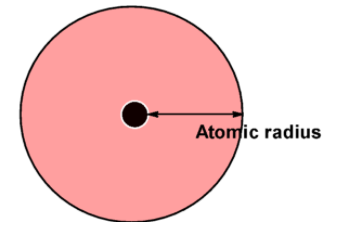
COVALENT RADIUS
E.g. the inter-nuclear distance between two hydrogen atoms in hydrogen molecule is 74 pm. Hence the covalent radius of hydrogen is 74/2 = 37 pm.
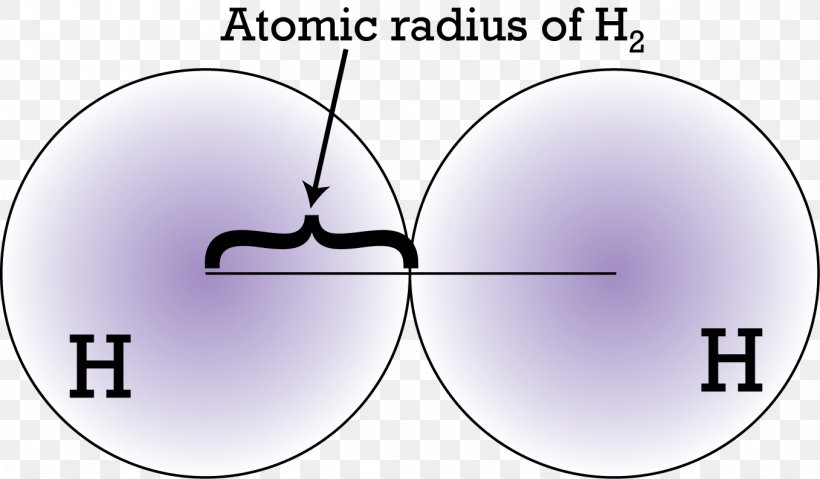
Similarly the inter nuclear distance between two chlorine atoms in chlorine molecules (Cl2) is 198 pm. Hence the covalent radius of chlorine atom is 198/2 = 99 pm.

Van der waal’s radius
Ans :- since noble gases do not form covalent bonds and therefore only weak physical forces are operative in the crystals of noble gases.
Ans :- The atomic size of noble gases is measured in terms of van der waal’s radius and that of halogens in terms of covalent radius . The van der Waal’s radius is always greater than the covalent radius.
Q :- Covalent radius is smaller than van der waal’s radius . Why?
Ans :- A covalent bond is formed by the overlapping of atomic orbitals. The overlapping region shortens the inter nuclear distance while in case of van der waal’s forces there is no such overlapping and two nearest atoms of two neighboring molecules are relatively at larger distances. One half of their inter-nuclear distance will be more than the two similar atoms forming a covalent bond. Hence covalent radius is smaller than the van der Waal’s radius.

METALLIC RADIUS
It is one-half of inter-nuclear distance between two nearest atoms in the metallic lattice.
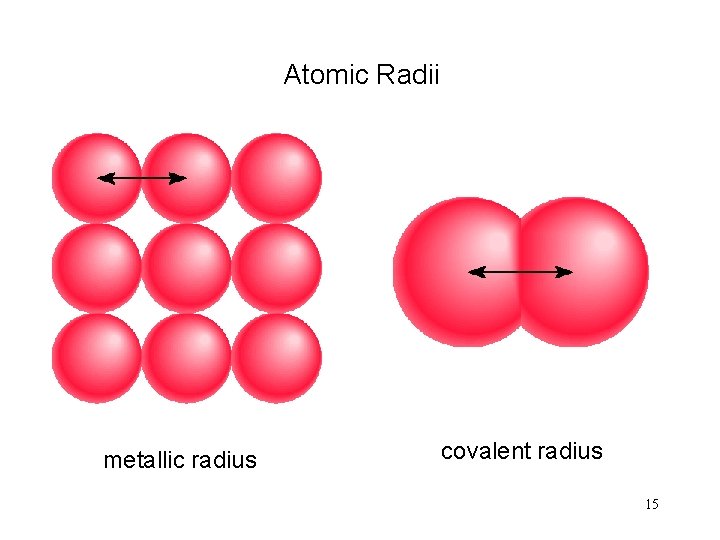
Increasing order of different types of radii
Covalent radius < Metallic radius < Van der waal’s radius
Q: - Explain the variation of atomic radius in the periodic table?
Ans: - Variation of atomic radius in a period:- In general the atomic radius decreases as we move from left to right in a period.


VARIATION OF ATOMIC RADIUS IN A GROUP:-As we move from top to bottom in a group the atomic size increases.


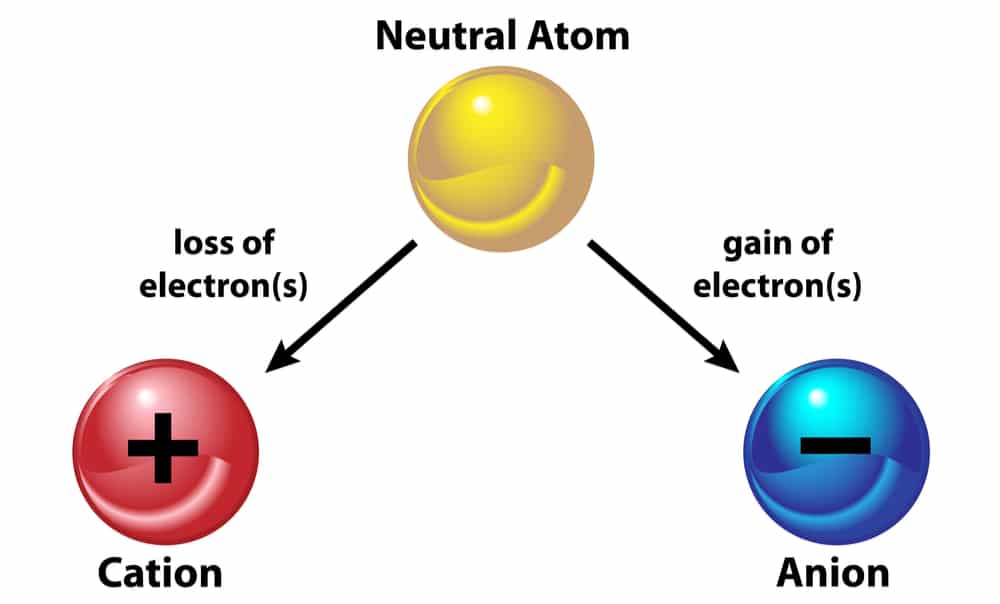
Q: - What are ions?
Ans: - When a neutral atom losses or gains electrons, ions are formed.
They are of two types:
1) Cations: - The ions formed by the loss of electrons from a neutral atom are known as cations.
2) Anions: - The ions formed by the gain of electrons by a neutral atom are called anions.

(II) IONIC RADIUS
It is the effective distance from the center of nucleus of an ion upto which it exerts an influence on its electron cloud.

CHARACTERISTICS OF IONIC RADII
1) The size of the cation is always smaller than its neutral atom
2) Radius of anion is more than that of its parent atom.
Q :- The size of the cation is always smaller than its neutral atom ? or
Q :- The radius of the cation is always smaller than its parent atom?
Ans: - Anion is formed when a neutral atom gains electrons. In this anion the magnitude of nuclear charge remains the same as that in its parent atom but the number of electrons increases. As a result of which the same nuclear charge exerts lesser attractive force on relatively larger number of electrons. This causes expansion of electron cloud and size of the anion increases as compared to its parent neutral atom. E.g. Atomic radius of chlorine =99 pm and chloride ion = 131 pm.

Q: - Explain the variation of ionic radius within a period and group in the periodic table?
1) Variation of ionic radii in a period

2) Variation of ionic radii in a group
Variation of cationic radii in a group:
Variation of anionic radii within a group:
(III) IONIZATION ENERGY:
This concept is applicable where more than one electron need to be removed and then this is done one after the other that is in succession and not simultaneously.
FIRST IONIZATION ENERGY (IE1):- The energy required to remove first electron from an isolated neutral gaseous atom to form a univalent cation is called first ionization energy.
SECOND IONIZATION ENERGY (IE2) :- The energy required to remove 2nd electron from the univalent ion is called second ionization energy.
THIRD IONIZATION ENERGY (IE3) :- The energy required to remove 3rd electron from the divalent ion is called third ionization energy.
M2+ (g) + IE3 → M3+ (g) + e-
IE1 < IE2 < IE3
M+ (g) + IE2 → M2+ (g) + e- (1795 kj/mol)
M2+ (g) + IE3 → M3+ (g) + e- (2758 kj/mol)
FACTOR ON WHICH IONIZATION ENERGY DEPENDS
2) Nuclear charge: - IE increases with the increase in magnitude of nuclear charge.
f < d < p < s
5) Symmetry of electronic configurations: - Greater the symmetry of electronic configuration more will be its stability and thus higher will be the value of IE.
1) Variation along a period:-In general, as we move from left to right in a period, the ionization enthalpy increases.
Reason:-
2) Variation down the group: - As we move down the group, the ionization energy decreases.
Reason:-
IV) ELECTRON AFFINITY OR ELECTRON GAIN ENTHAPLY:-
SUCCESSIVE ELECTRON GAIN ENTHALPIES
First electron gain enthalpy for most of the elements is taken as negative and successive electron gain enthalpies are taken as positive. If the energy is released (exothermic) the electron gain enthalpy will be negative and if energy is supplied (endothermic) then it will be positive.
REASON: - When a neutral gaseous atom gains an electron, a uninegaitve ion is formed. The energy released is called first electron gain enthalpy. However the addition of second electron to the uninegaitve ion is strongly opposed due to inter electronic repulsions. Hence energy is supplied from outside for the addition of second electron to overcome these repulsive forces. That is why the second electron gain enthalpy has positive value.
Q: - The first electron gain enthalpy for most of the elements is negative. Why?
FACTORS ON WHICH ELECTRON GAIN ENTHALPY DEPENDS
2) Nuclear charge: - The electron gain enthalpy becomes more negative with the increase in nuclear charge. Because the force of attraction between the nucleus and the incoming electron increases .
3) Symmetry of electronic configurations: - The electron gain enthalpies have positive values for the elements with symmetrical electronic configurations. Because these elements do not have any urge to take up extra electrons .As result energy has to be supplied to add an electron and therefore their electron gain enthalpies are positive.
PERIODIC TREND FOR ELECTRON GAIN ENTHALPY
REASON: - As we move across a period from left to right the atomic size decreases and nuclear charge increases. Both these factors result in greater attraction for the incoming electron and hence electron gain enthalpy becomes more and more negative.
2) VARIATION ELECTRON GAIN ENTHALPY IN A GROUP: - In general it becomes less negative as we move down the group.
REASON:-As we move down the group, both the atomic size and nuclear charge increase. But the effect of increase in atomic size is much more pronounced than the nuclear charge due to shielding effect. As a result, the attraction between the nucleus and incoming electron decreases and hence the electron gain enthalpy becomes less negative.

(V) VALENCY
Step 1
Step 2
Step 3
TYPES OF VALENCY
2) VARIABLE VALENCY:- The valency of an element is said to be variable if it is not fixed. Elements with variable valency possess more than one valency..E.g., Cu and Sn. The name of the element with lower valency in a compound end with a suffix ous while with higher valency ends with a suffix ic.

PERIODIC TREND IN VALENCY

VARIATION OF VALENCY DOWN THE GROUP
REASON :- This is due to the fact that all the elements in a group possess same number of valence electrons. That is why they exhibit a common valency.
(VI) ELECTRONEGATIVITY
Q: - What is Electronegativity?
FACTORS THAT INFLUENCE ELECTRONEGATIVITY
II) NUCLEAR CHARGE:-Electronegativity increases with the increase in nuclear charge of an atom.
PERIODIC TREND OF ELECTRONEGATIVITY
REASON: - This is because as we move along a period from left to right, the nuclear charge increases and atomic size decreases. As a result of which nucleus exerts a strong pull on the bonded electrons.
2) VARIATION OF ELECTRONEGATIVITY IN A GROUP:-The Electronegativity values decrease down the group. E.g. Among halogens fluorine has highest Electronegativity value.
REASON: - This is because when we move down the group, there is an increase in atomic size and screening effect. This over weighs the increased nuclear charge and thus the attraction between nucleus and bonded electrons decreases.
APPLICATIONS OF ELECTRONEGATIVITY
2) TYPES OF COVALENT BONDS:- Depending upon the electronegativity of bonded atoms the covalent bond may be polar and non-polar. E.g HCl,Cl2,H2 etc.
(a) POLAR COVALENT BOND :-If a covalent bond is formed between two dissimilar atoms having different electro--negativity values then the shared pair is displaced towards more electronegative atom. Such a bond is called polar covalent bond. E.g. H—Cl,H—F ,H—O—H ,NH3 etc.
(b) NON-POLAR COVALENT BOND :-If a covalent bond is formed between the two identical atoms then the shared pair of electrons will lie exactly in the middle of both the atoms. Such a bond is called non-polar covalent bond. E.g. H2,Cl2,Br2,O2 etc.
3) COMPARISON OF POLARITY OF MOLECULES: -(it means out of the given polar molecules which one has more polar covalent bond.) The polarity of a molecule is measured in terms of its dipole moment.( Polar molecules always have some dipole moment. It helps to compare the relative polarities of the molecules.) Greater the value of dipole moment more will be the polarity of the molecule. (It is the product of magnitude of charge and bond length.) Higher the electronegativity difference between the two bonded atoms more is the dipole moment of the molecule and hence more will be the degree of polarity of a covalent bond. It keeps on decreasing as the electronegativity difference between the two bonded atoms decreases.

(VII) DIAGONAL RELATIONSHIP

CAUSE OF ANOMALOUS BEHAVIOUR OF FIRST ELEMENT OF EACH GROUP
2) Absence of vacant d-orbitals in the valence shell
3) High ionization energy
4) High electronegativity.
5) Ability to form pπ-pπ multiple bonds(e.g. C ,N and O)
CHEMICAL PROPERTIES OF THE ELEMENTS
Important chemical properties are:
1) Electropositive nature :
2) Electronegative nature
3) Reducing character
4) Oxidizing character
5) Metallic character
6) Non metallic character
7) Reaction with oxygen
PERIODIC TREND IN THE CHEMICAL PROPERTIES OF THE ELEMENTS
2) ELECTRONEGATIVE NATURE: - Elements with electronegative nature have the tendency to gain electrons and acquire negative charge. This character increases as we move along a period from left to right. E.g. halogens placed on the extreme right of the periodic table are the most electronegative in nature.
3) REDUCING CHARACTER:-Elements which are electron donor are called reducing agents. This character decreases from left to right along a period. E.g. alkali metals placed at the extreme left of the periodic table are good reducing agents.
4) OXIDIZING CHARACTER: - Elements which are electron acceptor are called oxidizing agents. E.g. halogens placed on the extreme right of the periodic table are good oxidizing agents.
5) METALLIC CHARACTER: - Elements which are electropositive in nature are metals. This character decreases along a period. E.g. alkali metals placed at the extreme left of the periodic table are the most metallic elements.
6) NON-METALLIC CHARACTER: - Elements which are electronegative in nature are non-metals. Non-metallic character of the elements increases along a period from left to right. Hence halogens are most non-metallic elements.
7) REACTION WITH OXYGEN:-The binary compounds of elements with oxygen are called oxides. Along a period the basic character of oxides decreases and acidic character increases.
I) The elements present on the extreme left form basic oxides. E.g. Na2O, MgO.
II) Whereas those present on the extreme right form acidic oxides. E.g. P2O5, SO2,, Cl2O7.
III) Elements present in the center of the periodic table form amphoteric oxides. E.g. Al2O3 , SiO2 .
DOWN THE GROUP:-
1) ELECTROPOSITIVE NATURE:- Increases down the group.
2) ELECTRONEGATIVE NATURE: - Decreases down the group
3) REDUCING CHARACTER:- Increases down the group
4) OXIDIZING CHARACTER: - Decreases down the group
5) METALLIC CHARACTER: - Increases down the group
6) NON-METALLIC CHARACTER: - Decreases down the group
7) OXIDES:- Basic character increases down the group.
CHEMICAL REACTIVITY
Write down the chemical reactions
Q:- Why do we call f-block elements as rare earth elements?
Ans:- Because they are rarely found in earth crust.
Q :- Why do we place lanthanides and actinides at the bottom of the periodic table?
Ans :- Because they resemble with each other but do not resemble with any other group elements.
Q :- Why are cations smaller than neutral atoms?
Ans :- Because their effective nuclear charge is greater than the neutral atoms
Q :- Why do anions have bigger size than neutral atoms?
Ans :- Because their effective nuclear charge is less than the neutral atoms.
Ans :- The chemical species or ions containing same number of electrons but different nuclear charge are known as iso-electronic or iso-electronic ions. E.g. O2-, Na+, F- and Al3+ are iso-electronic because each of them contains 10 electrons.
Ans: - The process of shielding or screening of valence shell electrons form the nucleus by the inner shell electrons is called screening effect. In other words the inner shell electrons act as a shield between the nucleus and valence shell electrons .As a result of which the outermost electrons do not feel the full charge of the nucleus. In simple words the force of attraction between the nucleus and valence shell electrons decreases due to the presence of inner shell electrons.
Q: - What is effective nuclear charge?
Ans: - The actual nuclear charge felt or experienced by the valence shell electrons due to the screening effect is called effective nuclear charge. It is denoted by the symbol Zeff or Z*. It is obtained by subtracting screening constant from the total nuclear charge as follow:
Zeff = Total nuclear charge (Z) – screening constant(S)
Here Z* is effective nuclear charge which is always less than the total nuclear charge. S is screening constant and it is the measure of magnitude of shielding effect of inner shell electrons. It is calculated using Slater’s rule. Greater the number of screening electrons greater will be the value of screening constant hence larger will be the screening effect.
Ans:- Formula to calculate effective nuclear charge is:
Zeff = Total nuclear charge (Z) – screening constant(S)
Now total nuclear charge for the carbon atom is Z = 6. As atomic = number of electrons or Number of protons in a neutral atom.
Now screening constant S can be calculated using Slater’s rule which is as follow:
1) Write electronic configuration and make groups. S and p orbitals of a shell are written together whereas d and f orbitals are written separately.
Electronic configuration of carbon = (1s2) (2s2 2p2)
2) For nth group each electron other than the one under consideration contributes = 0.35.
3) Each electron of n-1 group contributes = 0.85
S = (0.35*3)+(0.85*2) = 2.75
Z* = 6 -- 2.75
Z* = 3.25 Ans.
(2) Numerical :- Calculate effective nuclear charge for one of the outer electrons of oxygen atom.
Ans :- Electronic configuration of oxygen = (1s2) (2s2 2p4)
S = (0.35*5)+(0.85*2) = 1.75+1.70=3.45
Z = 8
Zeff = (Z) – (S)
Z* = 8 – 3.45
Z* = 4.55 Ans.-
NOMENCLATURE OF ELEMENTS WITH ATOMIC NUMBERS > 100
Thus, the new element first gets a temporary name, with symbol consisting of three letters. Later permanent name and symbol are given by a vote of IUPAC representatives from each country. The permanent name might reflect the country (or state of the country) in which the element was discovered, or pay tribute to a notable scientist. As of now, elements with atomic numbers up to 112, 114 and 116 have been discovered. Elements with atomic numbers 113, 115, 117 and 118 are not yet known.
Q:-What would be the IUPAC name and symbol for the element with atomic number 120?
BOND LENGTH: - The inter nuclear distance between the two bonded atoms is called bond length.
Heat of atomization: - the energy required to isolate an atom from solid is called heat of atomization.
DIPOLE
𝞵 = q ⨯ d

UNITS :-Its units are Debye and denoted by the symbol D. The Debye is a CGS unit (a non SI unit) of dipole moment which is named in honor of the physicist Peter J. W. Debye.
and bond length 1.0×10⁻⁸ cm
μ = q × d
μ = 1.0×10-10 esu × 1.0×10-8 cm
μ = 1.0 * 10-18 esu cm
then the dipole moment is said to be one Debye hence
1 Debye = 1.0 * -18 esu cm
Relationship between CGS unit (esu cm) of dipole moment and SI unit (C m)
DIPOLE MOMENT FOR 100% IONIC MOLECULE
q = 4.803 × 10⁻¹⁰ esu .
Or q = 1.602 * 10 -19 C
This charge is equal to the charge on an electron.
Hence in order to calculate dipole moment assuming polar molecule 100 % ionic we will multiply this charge with bond length of the molecule:
μ = q × d
One esu cm = 3.335 * 10 -30 C m
DIPOLE MOMENT NUMERICAL
2) In polar LiH molecule the magnitude of charges on Li-atom and H-atom is 3.69 × 10⁻¹⁰ esu . The bond length between them is 1.596 × 10⁻⁸ cm. Calculate dipole moment of LiH molecule.
Ans :- 5.89 D
3) The magnitude of charges in KCl is 3.85 × 10⁻¹⁰ esu and bond length is 2.6 × 10⁻⁸ cm. Calculate dipole moment of KCl.
Ans :- 10 D
4) A covalent molecules A– B has a bond length of 150 pm. Calculate the dipole moment of this molecule if it were 100 % ionic.
Ans :- 7.2 D
5) The observed dipole moment of a molecule A—B is 4.5 D and its calculated dipole moment is 7.2 D if it were 100 % ionic. Calculate its percentage ionic character?
Ans= 62.5 %
6) The observed dipole moment of KCl is 10 D. The inter-atomic distance between K+ and Cl- in this molecule is 2.6 * 10-8 cm . What will be dipole moment of KCl molecule if each atom carries opposite charges of one unit. Calculate the percentage ionic character of KCl.
Ans :- 80 %
7) The observed dipole moment of LiH is 5.89 D. The inter-nuclear distance between Li and H in the molecule is 1.596 * 10-8 cm . Calculate percentage ionic character.
9) The observed dipole moment of a molecule X—Y is 1.45 D and its bond length is 1.654 * 10-8 cm .Calculate percentage ionic character in this bond.
Ans :- 18.3 %
DIPOLE MOMENT OF POLY ATOMIC MOLECULES
There are two C=O bonds in CO2 .
The dipole moment of each C=O bond is 2.3D.
CO2 molecule has linear shape or geometry.
The net dipole moment of CO2 will be given by the vectorial sum of dipole moments of two C=O bonds


0 Comments