

The chemical reactions take place according to certain laws. These laws are known as laws of chemical combinations. These laws are as follow:
1) LAW OF CONSERVATION OF MASS
This law states that in a chemical reaction total mass of the reactants is equal to total mass of the products . Hence, matter can neither be created nor destroyed during a chemical reaction. This law is also called law of indestructibility of matter.
For example as per this law one mole of sodium chloride(58.5g) reacts with one mole of silver nitrate(170g) to form one mole of silver chloride(143.5g) and one mole of sodium nitrate(85g). Total mass of the reactants (228.5g) is exactly equal to the total mass of the products that is (228.5g).
NaCl + AgNO3 → AgCl + NaNO3
2) LAW OF CONSTANT COMPOSITION OR DEFINITE PROPORTIONS
This law states that a chemical compound is always made up of same elements.These elements always combine in a fixed proportion or ratio by mass.
E.g. In water Hydrogen and Oxygen always combine in the simplified ratio of 1:8 by mass. Similarly in CO2 carbon and oxygen always combine in the ratio of 3:8 by mass.
3.LAW OF RECIPROCAL PROPORTION
This law states that the mass ratio of two elements which combine separately with the fixed mass of third element is either same or some multiple of the ratio in which they directly combine with each other .

4) LAW OF MULTIPLE PROPORTIONS
This law states that when two elements combine to form two or more chemical compounds, then masses of the one element that combine with fixed mass of other element bear a simple whole number ratio with one another in the different compounds.For example.
1) Carbon and Oxygen combine to form two compounds
CO ratio = 12:16
CO2 ratio = 12:32
Here masses of oxygen bear whole number ratio of 16:32 in both the compounds which can be further simplified as 1:2.
2) Sulfur and Oxygen combine to form two compounds
SO2 ratio = 32:32
SO3 ratio = 32:48
Here masses of oxygen have whole number ratio of 32:48 in both the compounds, which can be further simplified as 2:3.
3.Nitrogen and Oxygen combine to form five compounds. Hence masses of oxygen bear simple whole number ratio of 1:2:3:4:5 in the above five different compounds.
|
Compound |
N2O |
NO |
N2O3 |
N2O4 |
N2O5 |
|
Mass of Nitrogen |
28 |
14 |
28 |
28 |
28 |
|
Mass of Oxygen |
16 |
16 |
48 |
64 |
80 |
|
At mass of Nitrogen |
14 |
14 |
14 |
14 |
14 |
|
Mass of O / N- atom |
8 |
16 |
24 |
32 |
40 |
|
Ratio of O mass |
1 |
2 |
3 |
4 |
5 |
Hence masses of oxygen bear simple whole number ratio of 1:2:3:4:5 in the above five different compounds.
5. GAY LUSSAC’S LAW OF GASEOUS VOLUMES
This law states that under similar conditions of temperature and pressure, the volumes of gases bear simple whole number ratio to one another in a gaseous reaction. Let us consider following two examples :
1). Reaction between hydrogen and chlorine:In this reaction, the simple whole number ratio between the volumes of gaseous reactants and products is 1:1:2.

2) Reaction between hydrogen and nitrogen:-In this reaction, the simple whole number ratio between the volumes of gaseous reactants and products is 1:3:2

6. AVOGADRO’S LAW
This law states that under similar conditions of temperature and pressure equal volumes of all gases contain equal number of molecules. E.g. 22.4 liters of any gas at STP contain Avogadro’s number of molecules (6.022*1023). In other words the volume of a gas is directly proportional to the number of moles of the gas.

Numerical
1.) A Helium balloon contains 0.10 moles of helium gas which occupies a volume of 2.4 L at 298K and 1 atm pressure. How many moles have we added if we inflate it to 5.6 L. (Ans :- 0.23 moles).
2) A balloon is filled with 22.4L of a gas and contains one mole of this gas. If balloon is further inflated to make the final volume 32.7L.How many molecules of gas would it contain? {Ans:-1.46 mol).
3.)50 gram of oxygen gas has volume of 48 liters.If pressure and temperature are constant .The amount of the gas is changed and volume becomes 79 liters .How many grams of gas is now in the container.
Ans :-Hint n is in moles so first convert grams in moles .(Ans is 82.16 grams of oxygen)
ATOM
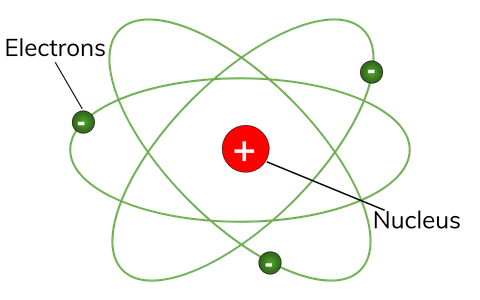
An atom is the building block of all matter around us. It is the smallest particle of an element.which takes part in chemical reactions. It has three-dimensional complex structure. It is further divisible into sub-atomic particles like electrons, protons,and neutrons. These sub-atomic particles are referred to as fundamental particles. Generally, atoms are reactive in nature hence they are mostly found in the combined state and rarely in the free state.E.g.Na, Mg, H,C etc.
MOLECULE
It is the smallest particle of an element or a compound which exists in the free state. It is made up of two or more atoms which are held together by a chemical bond.E.g.H2,O2,N2,CO2 etc.

TYPES OF MOLECULES
2)MOLECULE OF A COMPOUND OR HETERO-ATOMIC MOLECULE:-If a molecule is made up of two or more atoms of different elements it is known as hetero atomic molecule.
E.g. H2O,CO2,NH3 ,,HCl etc.
ATOMICITY
It is the number of atoms present in one molecule of an element or a compound.E.g.N2 is diatomic,O3 is triatomic,P4 is tetra-atomic ,CO2 is triatomic etc.
Home


0 Comments